
From “Me” to “We”: Teaching Empathy and Community with Touchstones
By Sharon Thomas, Director of K-12 and Family Engagement Programs
For a long time as a teacher, I believed that some aspects of human behavior shouldn’t require instruction; people should “just have” these traits as part of our personalities. These traits included an intrinsic motivation to learn, a sense of empathy and respect toward others, and the ability to work well with other people on a task. I would become annoyed when the teenagers in my care would not exhibit these traits, and I would chalk up their behaviors to selfishness, poor parenting, or sometimes just meanness. (On reflection, this judgmental response is a little bewildering, given my own lifelong struggles working with others in a group.)
What experience and a great deal of professional learning over the years helped me realize is that people of all ages benefit from direct instruction on these traits. And, generally, we each need a great deal of time and practice to improve and strengthen those traits. When I reflect on my early years as a teacher, I see more clearly that the things I thought I “shouldn’t have to teach” were things I didn’t know how to teach. My resistance to teaching them was, on some level, a defensive posture because I didn’t have any idea where to begin. As an instructional coach, I’ve recognized that very resistance in other people many times over the years. If a teacher doesn’t feel equipped to teach something, it’s possible they will push back on the idea that they should even have to try. But with time, practice, and the right tools, they can grow as teachers and learners themselves, as they help their students to grow in ways their students may also never have imagined.
Collaborative discussion provides a unique vehicle for helping people learn how to change their behavior toward others. Traditional classroom discussion, in which students give “right answers” to teachers’ questions, is not very helpful in this regard. In contrast, discussion that focuses on group dynamics more than reading comprehension and on human interaction more than content coverage can bring about changes in the group that the participants benefit from in all aspects of their lives. Witnessing the “Me” to “We” shift in collaborative discussions involves seeing people in a discussion group become, over time, more attuned to each other’s needs, exhibit greater empathy toward each other, and grow their capacities to work collaboratively and share leadership.
How “Me” to “We” Works
In most classrooms, discussions are shaped primarily by the dynamics between the teacher and the students; teachers offer questions, and students hopefully give “right” answers. In return, the students receive praise both verbally and in the form of grades. Teachers and students become accustomed to describing this interaction as a “discussion,” and when teachers encourage students to interact with each other and less with the teacher, guess what happens? Students still look at the teacher more than they acknowledge their peers. They still recognize that the teacher is the question-asker and the person with authority and power in the room. This perpetuates the pressure and expectation to give “right” answers. In turn, those dynamics often lead to a quiet, perfunctory level of engagement and a lot of teacher frustration:
- “Why is no one talking?”
- “Why do they always look to me? I asked them to talk to each other!”
- “Why do they only give one-sentence, ‘popcorn-like’ responses to the questions?”
At the same time, a sense of competition for who gets to speak the “right” answer can lead to other counterproductive dynamics such as dominance, hostility, and debate. These situations arise because that habit—that routine focusing on teacher pleasing—has been engrained in children since their earliest years in school.
Learning new approaches and cultivating habits for true collaborative discussion takes time and consistent effort. This metamorphosis also requires a process (the Touchstones process) in which each student develops an enhanced awareness of all people in the room (especially those who aren’t the teacher).
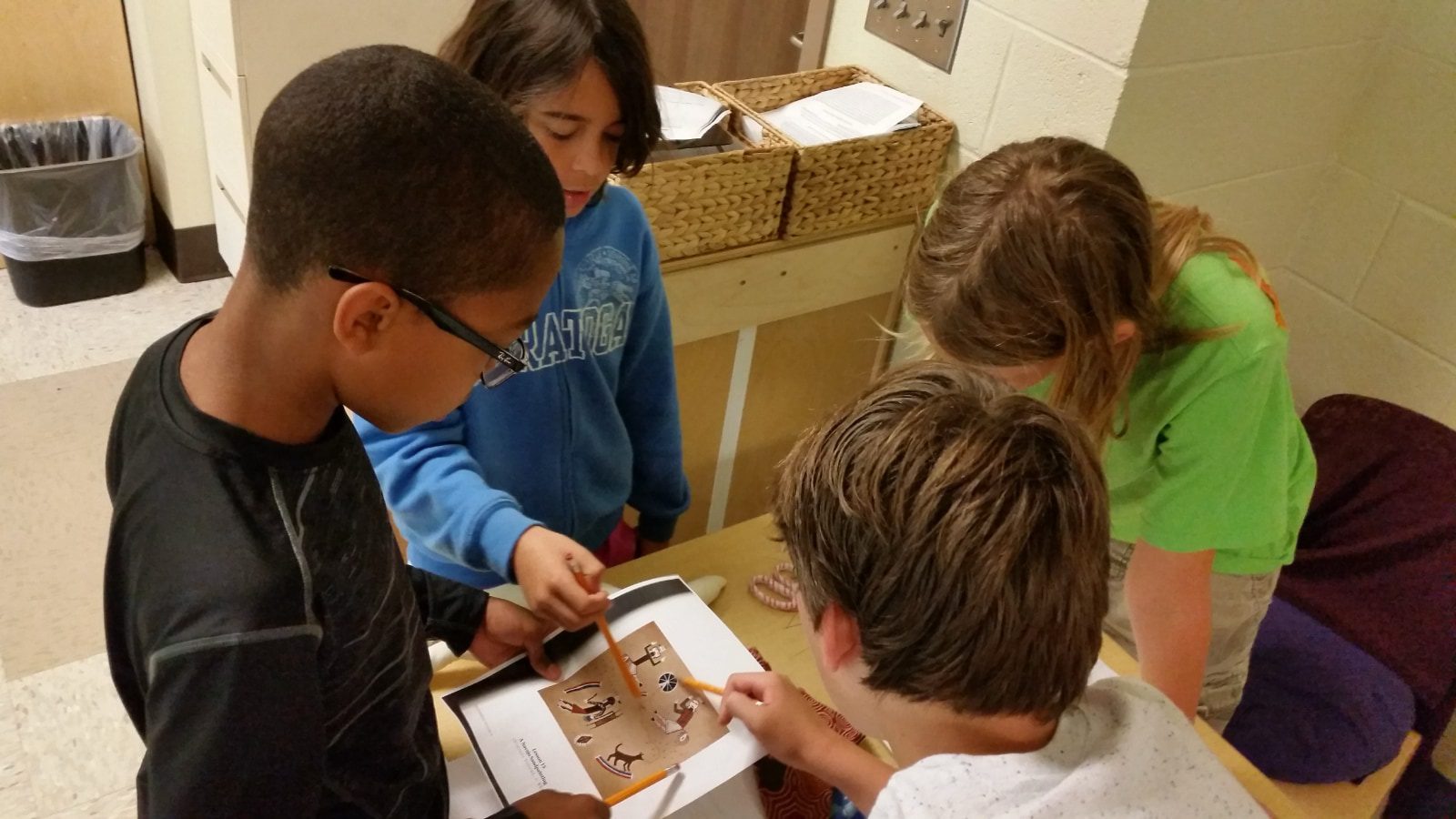
Through the six parts of the Touchstones lesson process, students practice becoming more aware of others as they become more aware of themselves as members of a group rather than as teacher-pleasers.
- Part 1: The reading of the Ground Rules establishes that student behavior and how they treat each other is central to the success of the discussion.
- Part 2: Reading the Text aloud gives all students access to it, regardless of perceived ability level. This sends a clear message that everyone is a legitimate member of the class and is welcome to share and explain their ideas, questions, and voice.
- Part 3: Individual Work gives each student time to connect to their own experiences and formulate an initial response to a prompt. This reduces the performance pressure that very often inhibits student participation.
- Part 4: Small Group Work supports students cooperating with each other, as they share ideas and questions without the pressure of speaking in front of the entire class. Small group reports segue all students back to the whole class.
- Part 5: Whole Group Discussion is now framed as part of a continuum of practice in sharing and exploring ideas together. It is no longer the most important part of the lesson or the time to showcase one’s mastery over content. Instead, it is a time to extend one’s practice in active listening and thoughtful response to a larger group.
- Part 6: The Discussion Evaluation invites students to reflect not on whether their answers were correct but instead to evaluate how well they worked together, how they treated each other, what they can do as a group to improve, what they can do as individuals to contribute to that change, and how they will turn those ideas about growth into actions.
Over time, week by week, with support from their teacher and each other, a shift begins. Students focus less on themselves and whether the teacher is pleased with their responses and more on what the others in the group are doing: “Who is completely silent? Can I help to engage them? Who is dominating the discussion? Is there something I can do to make space for others in the group?” The hallmark question in Touchstones is “What does the group need from me now?”
As students regularly engage in this process, that “me” to “we” shift is not only evident in Touchstones lessons but also in other interactions as well. Their new practice of thinking about “What does the group need from me now?” becomes evident throughout the day. That attention to the needs of others helps to develop deeper empathy for people who are struggling and appreciate differences among all people. In our research, in environments from schools to community groups to incarcerated people, we see Touchstones bring about this shift and significantly affect the relationships of the people in those groups. “Me” to “we” is real.
I was a new teacher once, with all the classroom management problems common to new teachers. I thought surely there was a magical way to be with students, a specific thing I was not doing or saying that would fix the problems I was experiencing in class. Classroom management was something I had to learn and practice, and I became even more skilled at it when I started using Touchstones. Touchstones lessons helped me to understand that each group is unique and has its own needs. My job as a teacher was to attend to those needs and not view myself as the gatekeeper of discussion but instead as the facilitator of it. Touchstones helped me to be a more effective leader of my students and helped my students to become more empathetic, more confident, and kinder human beings.
The truth is that behavior and relationships don’t change overnight through one magical phrase or act. Instead, what changes behavior and relationships are daily practice in doing so, a daily commitment to practicing those changes, and daily support from others around you. Over time, that practice fosters a more humanizing approach to everything that builds community and empathy among everyone. And that environment has a magic all its own.

 Join the